
An Environmentalist Undaunted by Data
Meet Darling Nogh.

Introduction: This year, I’ll write a series of profiles on Georgia environmentalists. It will be sort of a collection. In fact, I’ve been inspired by the book, The Tree Collectors: Tales of Arboreal Obsession by Amy Stewart. Stewart writes about 48 individuals who love trees in all kinds of ways, and reading the book makes me so happy to know these people are out there in our world. I hope that you will feel that same sense too, as we move through the year together learning about Georgians doing the steadfast and often unseen work for the landscapes, air, and water of our home state.
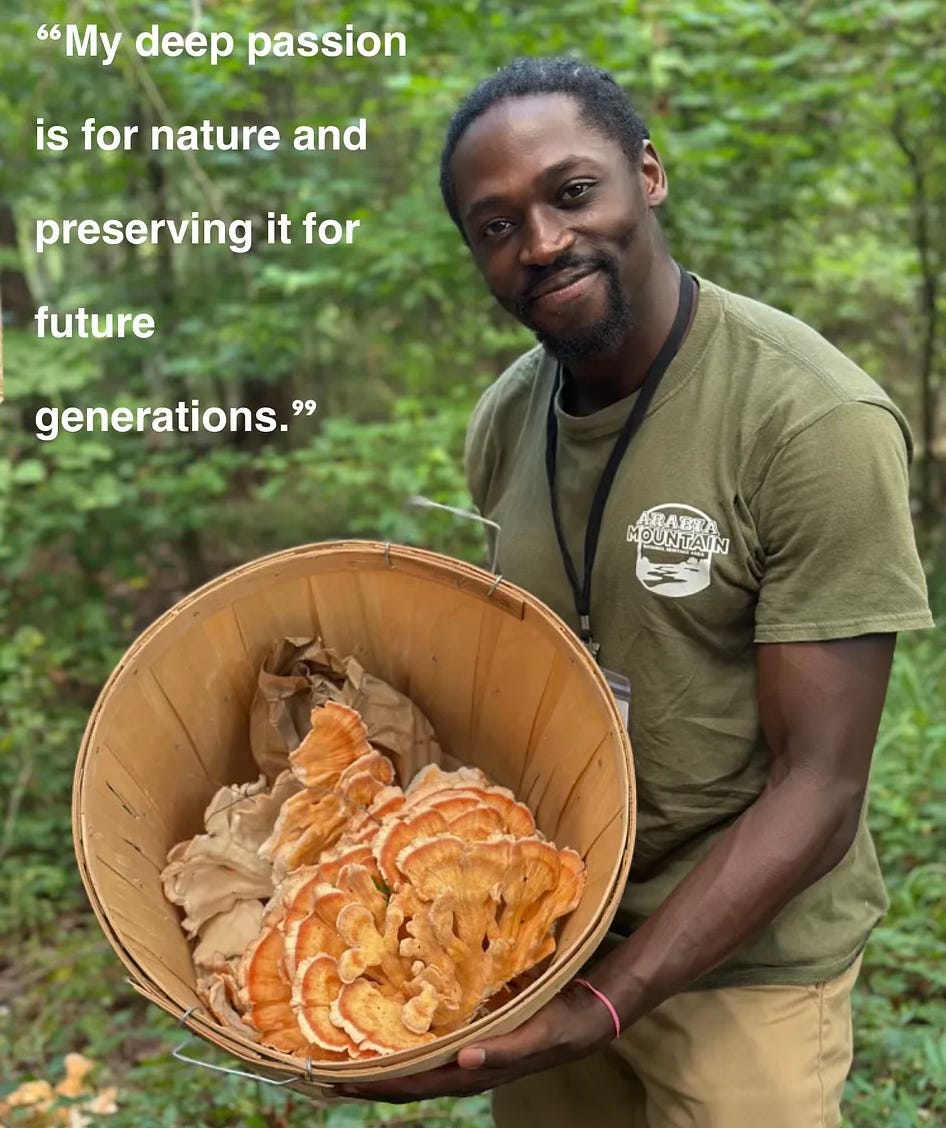
Profile number 1: Darling Nogh
Undergraduate student, data scientist, manager, park ranger.
I’ve met, or met up with, Darling a few times in 2025: twice at Mushroom Club of Georgia meetings, once after a mushroom foraging walk near Lilburn, and once when we got together to hike the Mason Mill trails on a beautiful summer day. Each time, I learned something new about him and came away impressed by the breadth of his interests. The profile below, presented in Q&A style, offers a sense of who he is. He has already been featured in other Atlanta-area publications, and I’ve included links to those pieces below. In one of those stories, a co-worker of Darling’s described him this way: “He’s like a living mycorrhizal network. His brain is beautiful.” Read on and see what you think.
What comes to mind first when you think of your interest in nature?
My main interest is in observing and interpreting the signals in the natural world. Signals are, to me, another way of saying data. Nature gives us an abundance, and we are blessed at being in Georgia, a state that is diverse and has lots of signals across the board due to our wide variety of species.
Nature is constantly speaking in patterns, cycles, and signals. Here, there is lots of biodiversity and species distribution so there’s plenty to look into. My deep passion is for nature and for preserving it for future generations.
You juggle a lot of roles: student, park ranger, data scientist, organizer. How do all those threads fit together?
Yes, I’m an undergraduate student at Georgia State University, majoring in data science. I’ll graduate this spring. That’s my big priority. I’m also a weekend Park Ranger at the Arabia Mountain National Heritage Alliance, and I work four days a week as a business development manager at a Stone Mountain chiropractic clinic. I’m also the volunteer data scientist for the Mushroom Club of Georgia, and I created Hikes of Georgia (H.O.G.), a group that organizes guided hikes and offers immersive foraging experiences for nature enthusiasts.
Most of the time, I’m using technology in some way. For example, at GSU, for my recent capstone project, my team and I created an app that identifies native Georgia frogs by hearing their vocalizations. At Arabia, I created a dashboard that pulls together water quality data. Georgia offers a lot of opportunities.
You talk a lot about signals, patterns, and cycles. How does data science help you turn those into responsible action?
I enjoy data science because it helps me translate those patterns, cycles and signals that I mentioned earlier into actionable insight. The emphasis is on observation, monitoring, and tracking. Not necessarily on extraction. It goes hand in hand with principals that I try to educate visitors on at Arabia Mountain. Guidelines like leave no trace. Have as minimum an impact on the environment as possible. If there is an impact, make sure it is positive.
As a mycologist, yes I pick mushrooms but there are different levels to that and there are guidelines. For example, take no more than 30 percent of what you find. Take from the land with gratitude and awareness, spreading spores if you can to create conditions for more mushrooms.
Your connection to the land feels deeply rooted. Can you share some of your origin story and how it shaped the way you see nature today?
My whole nature mindset started when I was born a bright-eyed baby in Cameroon, a place entrenched with nature all around, deep jungles, coasts and rivers, and ample rainfall. I grew up in a farming, agro-pastoral household. Understanding that the land is a part of you is something I learned from an early age, and today I believe the land is one of the greatest benefits we have. It is ingrained in me. My parents instilled the thought in me that the land is one of the first things that loves us.
We invigorate ourselves physically and mentally with the land. Besides farming while growing up, we made it a habit to go out into nature to visit nature centers and gardens. My family is really big on community gardens, with a micro-farming culture going.
As we moved across the world, my family has always been great reminders of respecting the land.
You’ve evolved in many ways as you’ve grown. One shift was in how you learned to think about questions. Can you tell us more?
As I got older, I studied history, philosophy, and technology, and realized that fields like these have gained much of their foundations from observing the natural world. I learned about questioning, specifically, the difference between being deterministic or open-ended in my questions. A deterministic process leans toward predictability and the need to find an answer with a favored result. But that’s not how the natural world works.
Often, the most exciting answers are on the fringes. That keeps science going. The quality of our questions matters more than the goal we have in mind. The job of a data scientist is to frame those questions with the spirit of understanding the patterns, cycles, and signals we see. We don’t always get a neat, definite answer, and that’s okay. When it comes to nature, there is a lot we don’t know. We are still asking.
Looking ahead, what do you see your work life looking like after graduation?
I’ve always had an interest in health care and wellness, so I may go into those areas, focusing on data, or perhaps nature conservation, again on the data side of things. I’ve never minded obsessing over and mulling through data. I could do it for hours and never get bored if it’s an area I’m passionate about. If I choose data analysis for my career and stay in areas that inspire me, I won’t spend my life in drudgery, hour by hour, doing something I don’t like. I’ll actually love it. Plus, I know that data science is so needed in today’s world.
I often talk about community science as something anyone can do while outdoors that meaningfully supports research. What are your thoughts on how this information is essential to scientific discovery?
Citizen science really is the bedrock of much of the research being published and the insights found by researchers. With the rise in the last two decades of apps and programs like iNaturalist, FungiFinder, Merlin, and others, regular old everyday people, can be the catalyst for scientific discovery and research. We get back to one of my main themes: nature is constantly speaking and giving us patterns, cycles, and signals. No one scientist can be in all these places, so community scientists are great at adding to the scientific body.
Apart from that, community science gives us a great way to learn more about ourselves. We are part of the environment, and as we discover the world around us, we discover more about ourselves.
What books or documentaries do you recommend for those interested in nature and science?
Nogh recommends these books and documentaries:
Braiding Sweetgrass by Robin Wall Kimmerer is a classic and foundational book that entertains while teaching how nature and humans are intertwined.
Entangled Life: How Fungi Make Our Worlds, Change Our Minds, and Shape Our Future by Merlin Sheldrake explores the hidden communication of fungal roots and how these networks help forests survive. Eighty to 90 percent of the trees in the world have some sort of fungal relationship. The forest is never without communication.
Documentaries:
Fantastic Fungi, available on YouTube, is a wonderful documentary with great visuals and insightful information; it is just an enjoyable watch.
My Octopus Teacher is an excellent example of nature storytelling. I love learning about creatures I didn’t know much about.
Read more about Nogh (pronounced no) at Foragers at the End of the World and at Inspiring Conversations with Darling Nogh of Hikes of Georgia.
Send me your suggestions for others to interview. See the comment section below.
I am already SO excited for this series! I am going to look into Hikes of Georgia. The idea of a guided foraging hike sounds cool to me!
Pam, another great article and what an exciting series you are starting- can’t wait to read more stories.
I met years ago Jonah McDonald who continues to work for DeKalb as a park ranger. His knowledge and enthusiasm was also contagious. You can check him out, in case you don’t know him already.
Happy new year full of nature and adventures.