Trees Laid Bare
Nature's fractals represent brokenness. There's plenty of that these days.

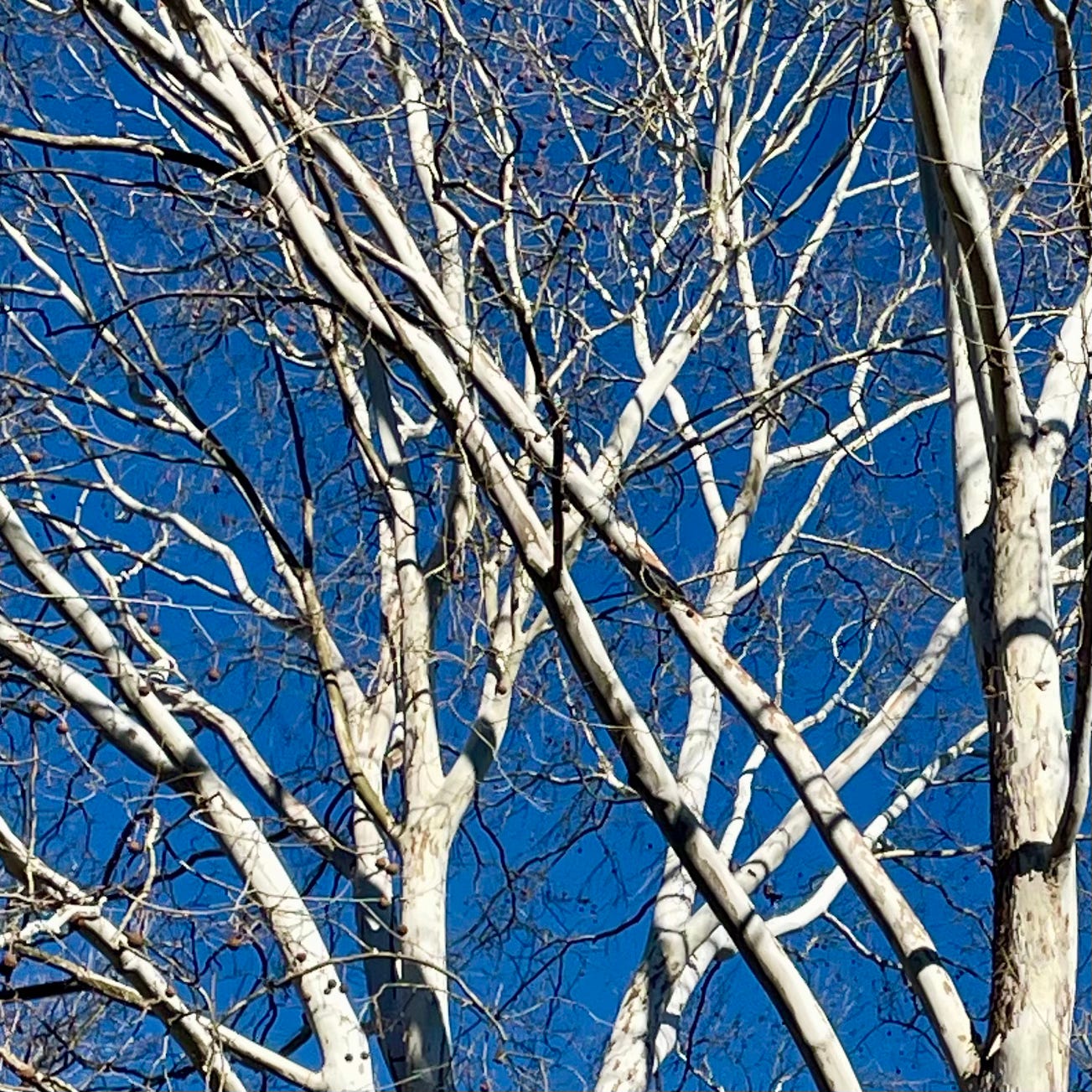
Last week, I went on a mission to look at some trees, up close and personal.
Even though it is wintertime.
While some may think leafless, bare branches are a drag, or at least giving cold and uninviting vibes, I didn’t want that. When I saw a chance to join a Trees Atlanta tree identification hike in a park near me, I jumped at the chance.
Our group of 15 or so gathered at Paces Mill Park. Looking around, you could feel the New Year’s optimism in the air, at least it felt that way to me. People were out there snappily closing car doors and getting to it. Fishermen hiking up their waders and checking their lines; birders with backpacks and binoculars; the runners, the hikers, a few weighted vests worn by some, hoping to amp up the effort.
The scene was busy, busier than I expected. I had started 2026 with a goal of getting out more and joining more in-person guided nature hikes, like this one. I was excited to be in the mix as I walked up to our group. To make it better, I had brought along a neighbor and friend who also loves being out on the trails.
Bringing a friend, I believe now after doing so many nature and community science projects for the last few years, really does double the fun, the learning, and the takeaways. We always have so much to talk about, and ask each other questions about, on the drive home or to lunch.
Besides being active, the park was quite crunchy. Georgia ended 2025 in drought conditions, and the new year was beginning with little to no rain. But the unseasonable 60-degree weather made it a light jacket day, which was nice and easy for us.
Now back to the trees.
You may ask: wintertime and trees? What is there to see now?
The answer is, so much! Now is bark time, dead leaf time, fractal time. And a whole lot more.
Our guide for the morning, volunteer Kent Watkins, gave us a quick overview of Trees Atlanta, then got right to it. We ambled over to our first leafless tree of the day. A Hackberry, aka Sugarberry.
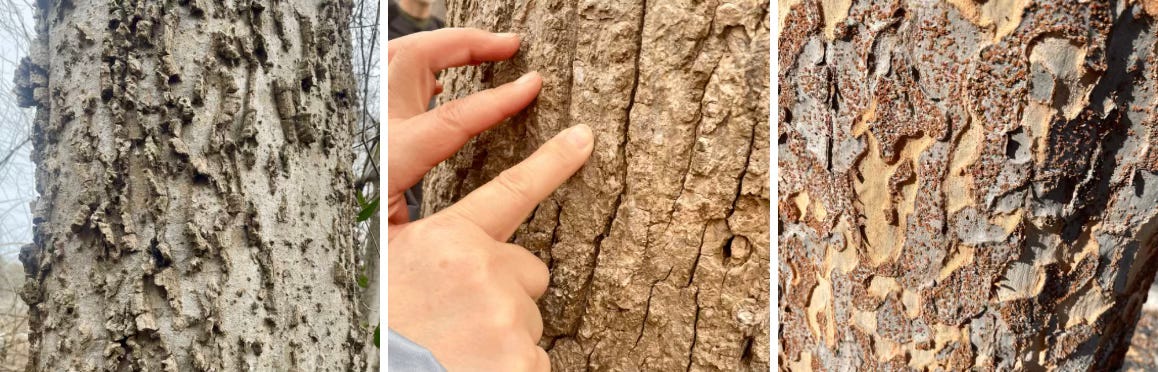
There, we gathered in close to the trunk of the tree. In the wintertime, the outer bark, the tree’s protection from the outside world, gets to take center stage since there are usually no leaves on the tree.
“Some people say the bark of a Hackberry is like looking at rows of canyons, lots of little grand canyons,” Watkins said, as we touched and looked closely. “Use your senses. Old-timers, well they’d look at the size of a tree, maybe chew a twig, touch the tree, they’d take their time with it.”
Watkins got us to thinking about bark as a biography of the tree. That was a new idea for me.
During our time together, we learned so much:
about the red oak group of trees and the white oak group and how to recognize the difference by looking at the leaves (white oaks have rounded lobes, reds have fiery pointed lobes). We used dead leaves on the ground to practice.
about river birches and how they like to keep their “feet” wet;
about how sycamore seed balls had been used in traditional medicine, and how to recognize the American sycamore by it’s bark;
about how to recognize a box elder as the tree that still hangs onto it’s dried-out brown leaves for a long time in winter;
about Watkins, who is a Boy Scout leader. He brought the lore and the stories and the background information to life for us. Once he picked up an acorn and said, “The kids would always ask: is it edible? I’d tell them it may be eat-able, but probably not edible. It left them thinking.”
about ongoing discovery. “You can go out to the park and say wow look at all those trees. But isn’t it more fun to be able to name a few different species and recognize some of them? Then, you say ah, there’s a sycamore, or a river birch, or whatever.”
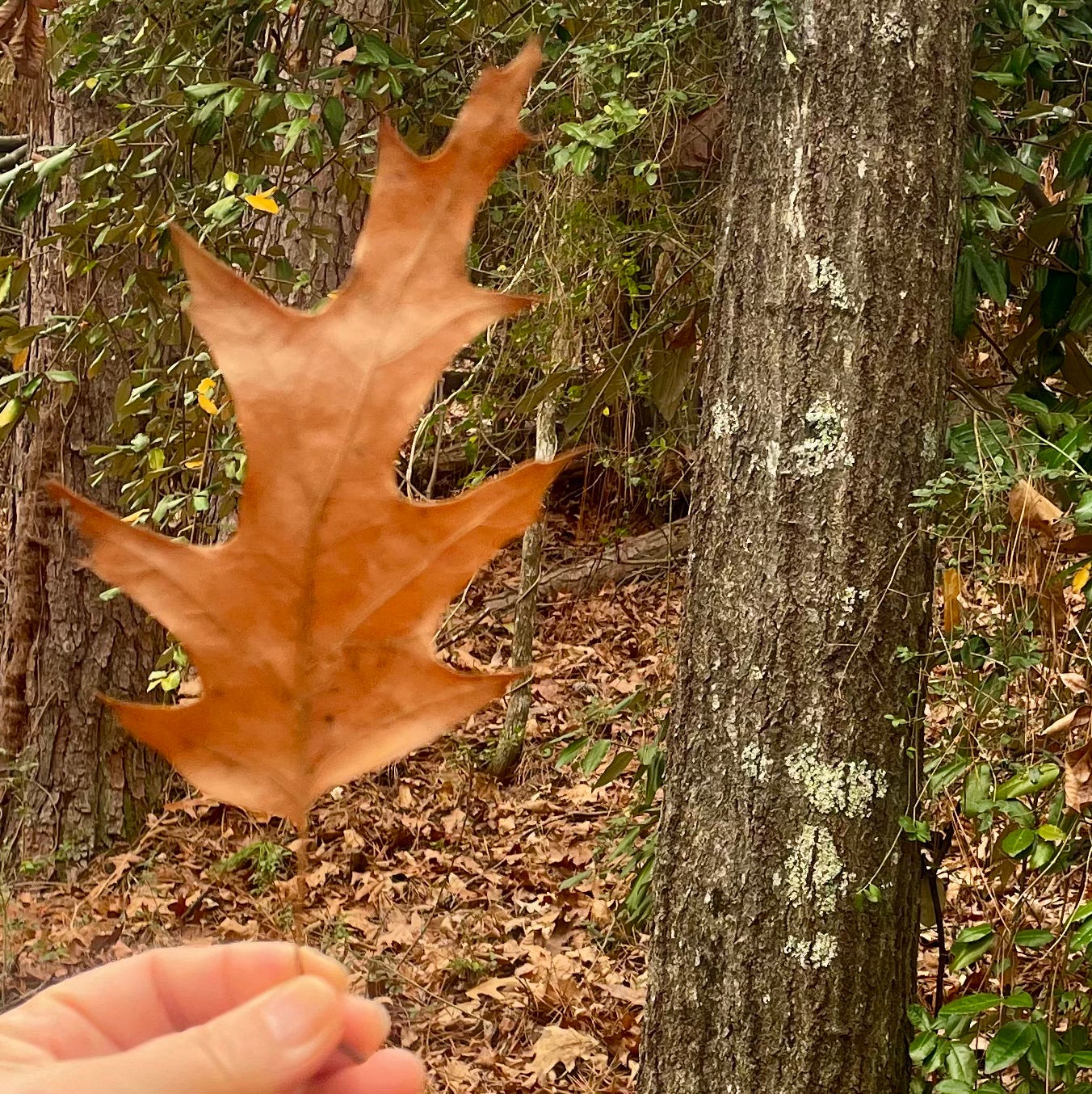
An oak leaf from the red group of oak trees. Pointy lobes remind you of fire, remind you of red, remind you of red oak.
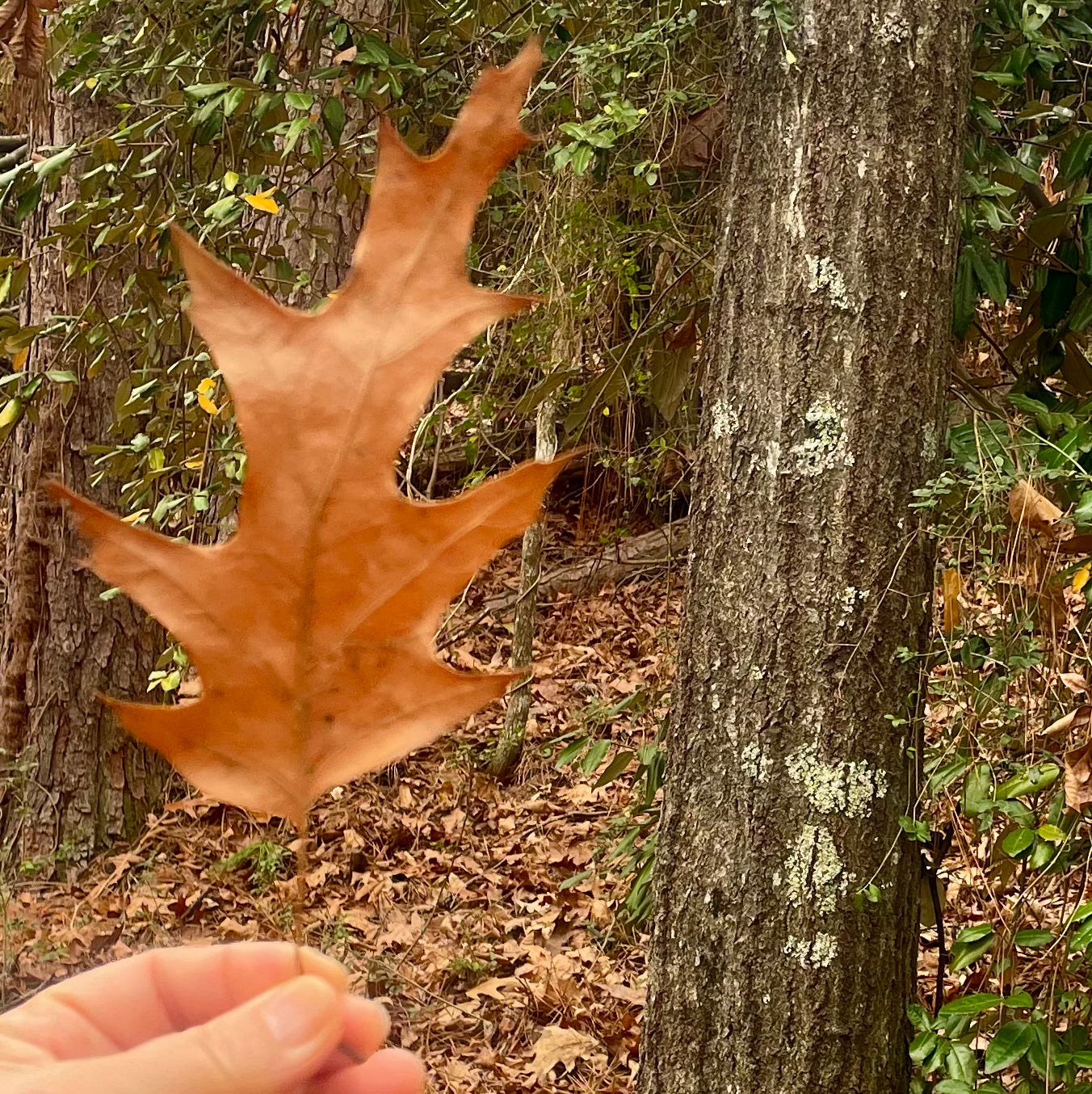
At the end of our time, Watkins advised: “Go home, think about all this, do your own research, maybe I’ve gotten you interested in some detail.”
I took his advice. Here’s what else I learned about trees in winter:
Fractals.
Fractals, repeating patterns that are similar but not exactly the same, are especially noticeable in certain living things like trees. Especially in tree branches in winter.
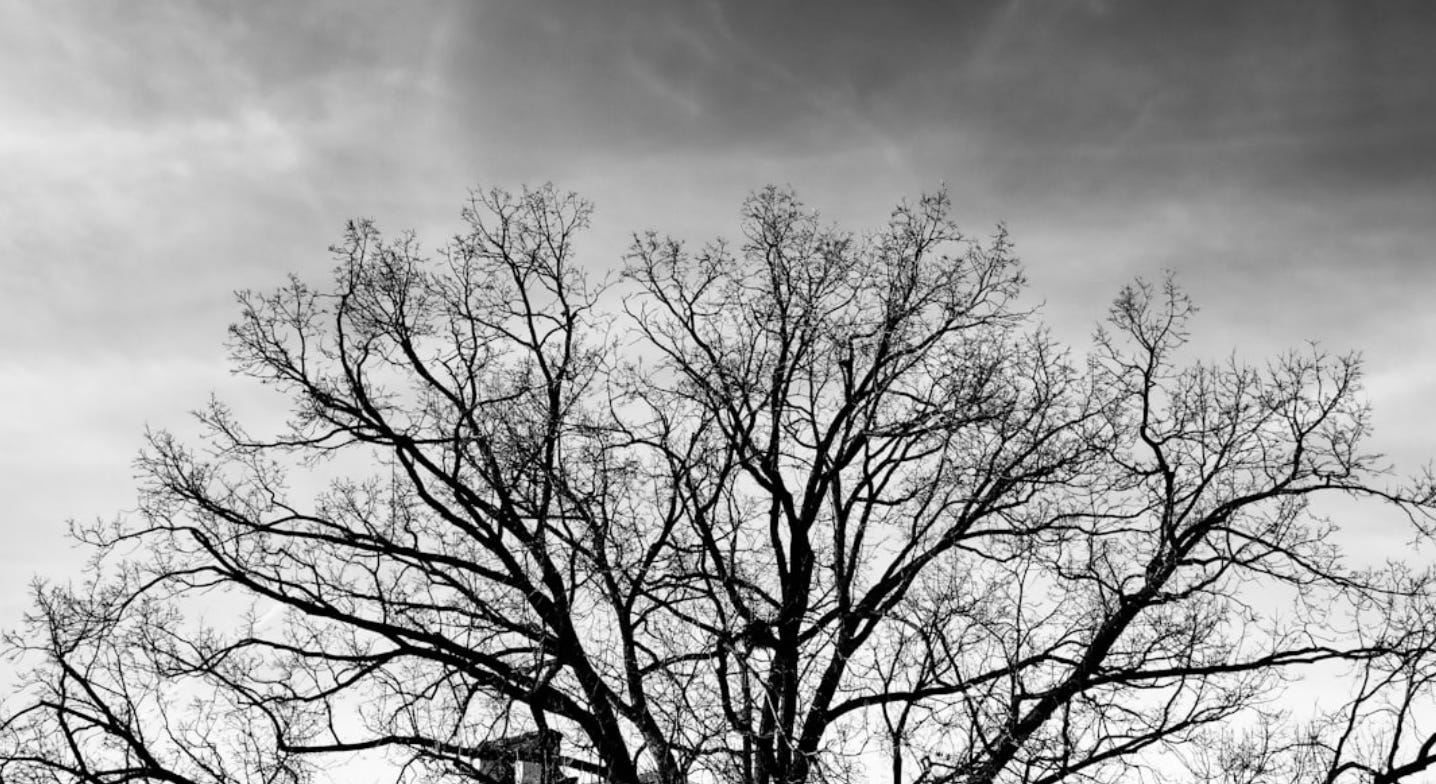
When I look, I can’t decide if I’m focusing on the sky behind the tree in the negative space, or if I am noticing the triangles and parallelograms and trapezoids. Either way, I realize now these scratches and spaces in the sky are nature’s fractals on display.
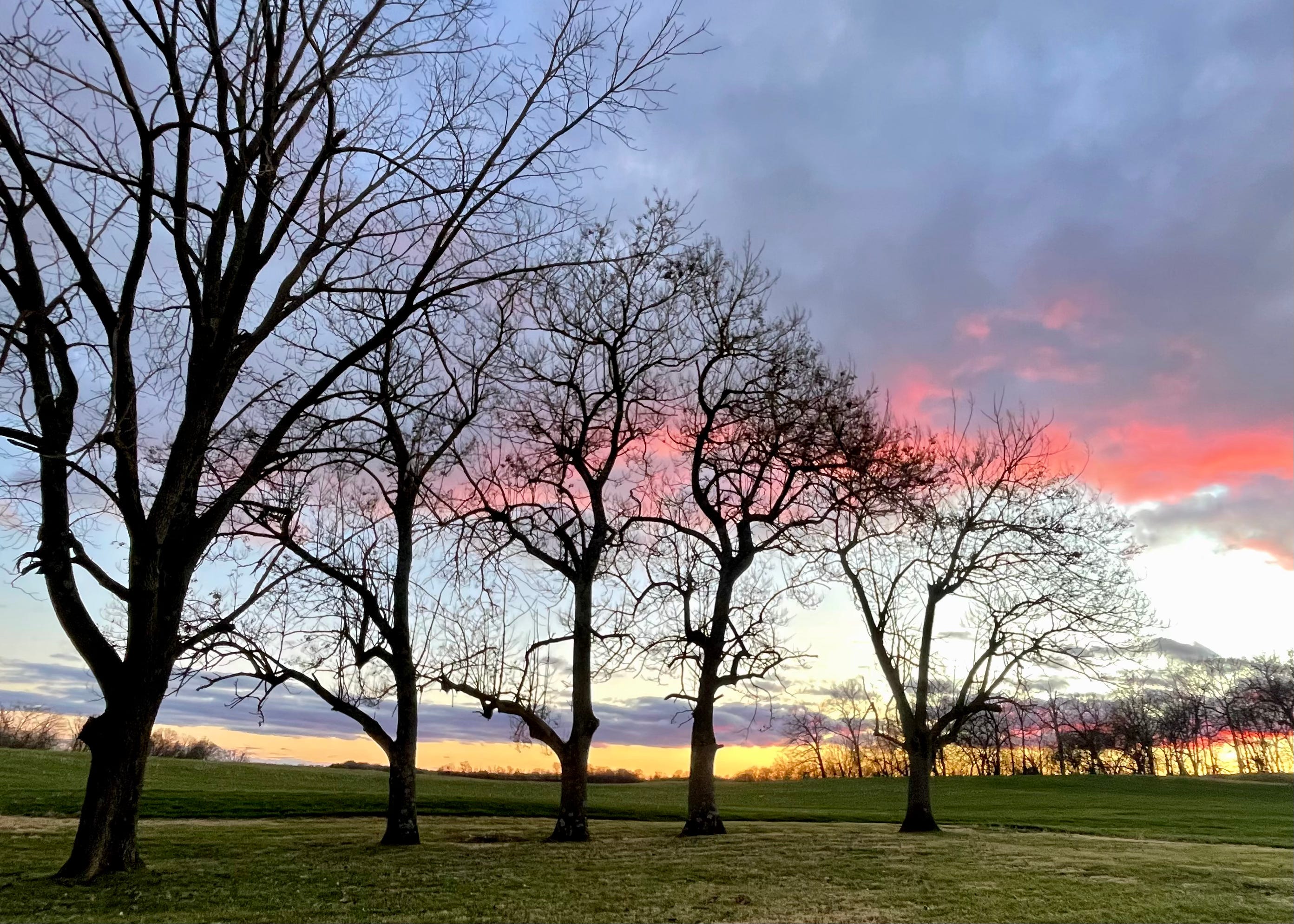
The word “fractal” comes from the Latin word fractus, meaning broken or fractured. A mathematician came up with the word to describe complex, similar shapes with fragmented, irregular structures. In America, a good bit of research about fractals in nature has been done at the University of Oregon. They’ve found that geometric patterns (found everywhere in nature) create visual ‘anti-stress’ moments for our brains, causing us to relax and experience lowered cortisol levels in only a few seconds.1
For a long time, I’ve been someone who likes to look up when hiking. And yes, I have to be careful about tripping. I do appreciate a smooth boardwalk. Anyway, now when I’m out, I’m always looking skyward for fractals.
Fractals! Such a rich topic to explore. Thanks for this wonderful piece, Pam!
Another beautifully written post. We're going for a walk today and I will look for fractals. Thanks.